Tesla China Battery Project – Renewable Energy, Megapack Expansion & Global Grid Transformation (2026)
Introduction to Tesla China Battery Project
The Tesla China Battery Project represents one of the most significant developments in global energy storage in 2026. Led by Tesla, the initiative focuses on scaling grid-level battery manufacturing and deploying Megapack systems to accelerate renewable energy adoption. While Tesla is globally recognized for electric vehicles, its energy division is rapidly becoming a core growth engine—especially in China.
The convergence of advanced battery manufacturing, China’s industrial scale, and accelerating renewable energy deployment creates a unique inflection point. China leads the world in solar and wind capacity additions, but renewable intermittency remains a challenge. The Tesla Shanghai Megapack factory addresses this issue directly by producing high-capacity battery systems capable of storing excess solar and wind energy and redistributing it during peak demand.
By 2026, global energy storage markets are shifting from pilot programs to large-scale infrastructure. Falling battery costs, improved efficiency, and supportive policies are transforming storage into a mainstream utility asset. China’s strategic role in Tesla’s roadmap is clear: deep supply chains, materials leadership, manufacturing efficiency, and proximity to Asia-Pacific export markets position it as a cornerstone of Tesla’s global energy ambitions.
The $556.8 Million Shanghai Grid-Scale Battery Deal
In June 2025, Tesla signed a 4 billion yuan ($556.8 million) agreement with China Kangfu International Leasing and the Shanghai Municipal Government to develop its first grid-scale battery storage station in China. This marked Tesla’s largest energy infrastructure investment in the country.
The deal goes beyond a simple construction contract. It establishes a public-private partnership aimed at stabilizing Shanghai’s electricity grid, supporting renewable integration, and replacing fossil-fuel-based peaker plants. The project is expected to become one of the largest grid-side battery storage facilities in China upon completion.
The system will deploy Tesla’s Megapack technology—each unit capable of delivering up to 3.9 MWh of energy. These batteries will act as “smart regulators,” balancing urban electricity demand and mitigating fluctuations caused by solar and wind generation. The June 20, 2025 announcement signaled Tesla’s deeper commitment to China not just as a manufacturing base, but as a strategic clean energy market.
Tesla Megapack Factory in Shanghai (Lingang Free Trade Zone)
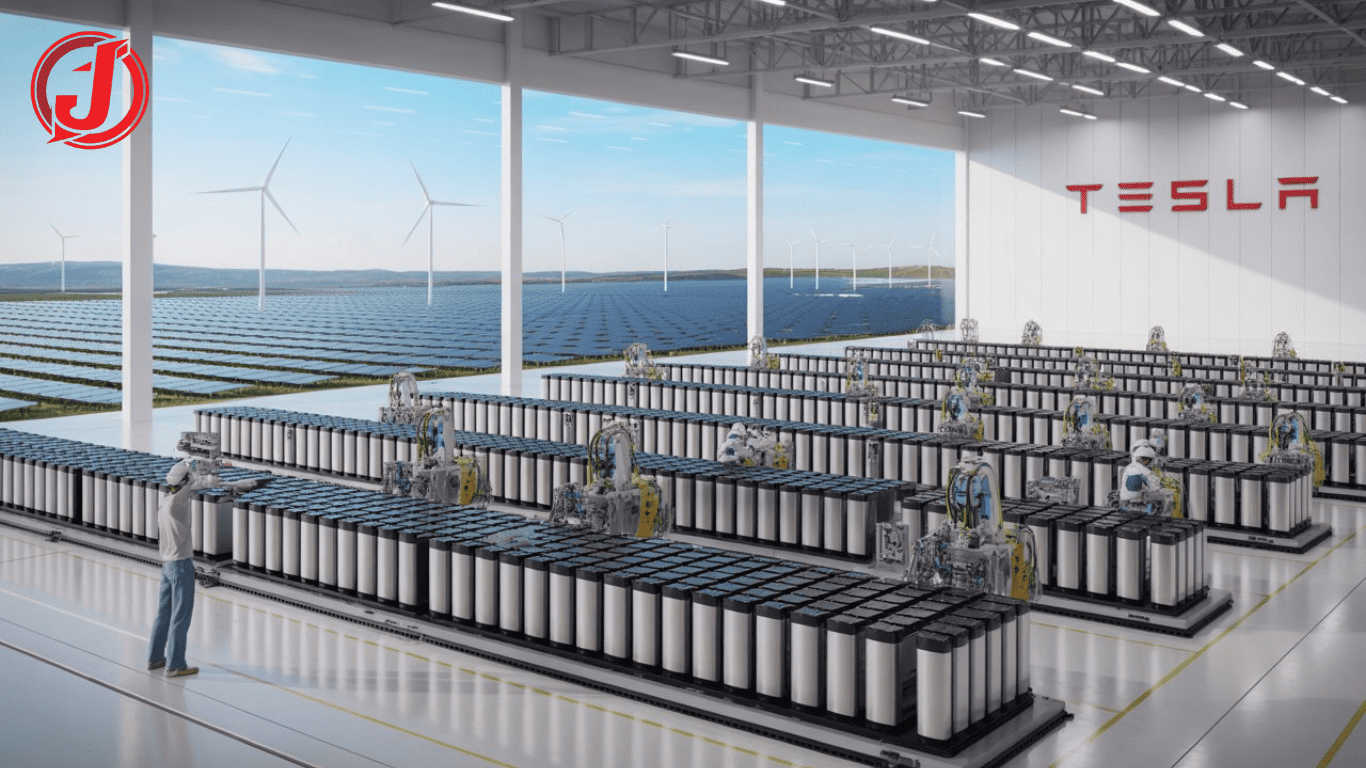
Tesla’s Megapack factory in Shanghai’s Lingang Free Trade Zone began production in February 2025. With an annual capacity of approximately 10,000 Megapacks (around 40 GWh), the facility significantly expands Tesla’s global energy output.
Lingang’s free trade status enhances supply chain efficiency by reducing customs friction, accelerating component sourcing, and simplifying exports. Some Megapacks have already been shipped to Australia and Europe, strengthening Tesla’s position in the Asia-Pacific energy storage market.
Integration into Shanghai’s clean energy ecosystem is another strategic advantage. The city aims to modernize its grid, incorporate more distributed solar generation, and reduce coal reliance. Tesla’s factory supports these goals by providing localized, high-capacity storage solutions that shorten deployment timelines and reduce costs.
What the Tesla China Battery Project Is—and Isn’t
This initiative focuses on stationary energy storage—not electric vehicle battery production. While Tesla’s Gigafactories are synonymous with EVs, the China battery project is specifically designed for grid-scale applications.
It is not a short-term subsidy-driven experiment. Instead, it represents industrial-scale execution aimed at throughput, reliability, and cost reduction. The project’s primary objective is to stabilize renewable-heavy grids and enhance system resilience.
Unlike vehicle battery lines optimized for energy density and compact form, Megapack production prioritizes durability, safety, long cycle life, and predictable performance under heavy cycling conditions. This distinction is crucial for utilities planning long-term infrastructure investments.
Core Components of the Project
High-Throughput Cell Manufacturing
Tesla’s China operations emphasize cost per kWh optimization. Automation, inline analytics, and yield improvements reduce manufacturing losses. By leveraging China’s established materials ecosystem, Tesla minimizes logistics costs and accelerates production cycles.
Utility-Scale Pack Assembly (Megapack Systems)
Megapacks are containerized, pre-assembled battery systems capable of rapid installation. Delivering up to 3.9 MWh per unit, they are designed for utility-scale deployment. Integrated thermal management and fire suppression systems enhance safety and reliability.
Software & Smart Grid Integration
Tesla differentiates itself through software. Megapacks utilize predictive dispatch algorithms that analyze weather forecasts, load curves, and electricity price signals. They participate in ancillary services markets, providing frequency response and voltage regulation within milliseconds.
Supplier Ecosystem Integration
Collaboration with Chinese battery leaders like CATL and BYD strengthens supply resilience. Local sourcing of cathodes, anodes, and power electronics reduces input volatility and improves scalability.
How Tesla’s China Battery Project Advances Renewable Energy
From Intermittent to Firm Power
Renewables are inherently variable. Solar peaks midday; wind fluctuates unpredictably. Tesla’s storage systems absorb surplus generation and discharge during peak evening demand, effectively converting intermittent generation into firm capacity.
Megapacks also provide frequency regulation services, responding in milliseconds to grid imbalances. This capability reduces reliance on fossil-fuel-based spinning reserves and supports deeper renewable penetration.
Grid Modernization & Urban Stability
Shanghai’s deployment includes a 6 MW rooftop solar array paired with 8 MWh of onsite storage. These distributed systems reduce transmission congestion and enhance local grid stability.
Battery storage also defers costly transmission upgrades. Instead of expanding physical infrastructure, utilities can strategically deploy storage to manage peak loads and improve resilience.
Investment Signals & Revenue Stacking Strategy
Revenue Streams
Grid-scale batteries generate income through multiple channels:
- Energy arbitrage (buying low, selling high)
- Capacity payments
- Ancillary services (frequency regulation, black-start)
- Long-term tolling agreements
This revenue stacking model improves asset bankability and reduces investment risk.
Financial Structure
China Kangfu’s leasing model lowers upfront capital costs for utilities. Instead of purchasing systems outright, operators can lease Megapacks, spreading costs over time and improving project feasibility.
China’s Rapidly Expanding Battery Storage Market
China’s grid-scale energy storage market generated nearly $2 billion in 2024 and is projected to grow at a 26.9% CAGR through 2030. National targets aim for 40 GW of battery capacity by 2025.
Globally, energy storage deployment surged, reflecting broader decarbonization trends. China’s manufacturing dominance in lithium refining and phosphate processing positions it as the epicenter of battery growth.
Technology Inside the Tesla China Battery Project (2026 Trends)
Chemistry Choices
Lithium Iron Phosphate (LFP) dominates stationary storage due to safety, longevity, and cost advantages. High-manganese chemistries are emerging as alternatives balancing resource availability and performance.
Format & System Integration
Prismatic cells housed in modular racks streamline maintenance. Integrated DC-to-AC conversion reduces onsite complexity, while advanced fire suppression systems enhance safety.
Software Optimization
AI-driven dispatch reduces degradation and maximizes revenue potential. Weather-informed forecasting enhances operational efficiency.
Supply Chain Advantages of China’s Manufacturing Ecosystem
China leads global lithium and phosphate refining. Port proximity supports export logistics, while recycling initiatives recover lithium and phosphate materials, reducing raw input volatility.
Competitive Landscape & Market Impact
Domestic competitors like CATL and BYD compete aggressively on cost. Tesla differentiates through vertical integration, software capabilities, and global project execution.
Large-scale deployment narrows peak-off-peak price spreads, stabilizes power markets, and lowers ancillary service procurement costs.
Policy, Trade & Geopolitical Considerations
Tariff risks and export rules influence global deployment strategies. Local assembly partnerships mitigate trade barriers. Grid interconnection frameworks determine revenue certainty.
Risk Factors & Mitigation Strategies
Execution risks include yield ramp-up challenges. Market risks involve arbitrage spread compression. Technical risks such as thermal runaway are mitigated through cell isolation and advanced suppression systems.
Implications for Utilities, Developers & Investors
Utilities must revise resource planning to reflect falling LCOS. Developers can pair solar and wind with right-sized storage for firm capacity blocks. Investors benefit from standardized EPC playbooks and long-term warranties.
Tesla’s Global Energy Strategy & Long-Term Outlook
Tesla’s expansion into grid-scale infrastructure signals diversification beyond automotive revenue. Aligning with China’s decarbonization roadmap enhances global competitiveness.
The Bottom Line: Why Tesla’s China Battery Project Changes Everything
Manufacturing in China leverages deep supply chains to drive down LCOS. By converting intermittent renewables into reliable power, Tesla reshapes electricity pricing dynamics and accelerates the global clean energy transition.
The Tesla China Battery Project is not merely a factory expansion—it is a strategic shift that positions energy storage as the backbone of the renewable-powered future.