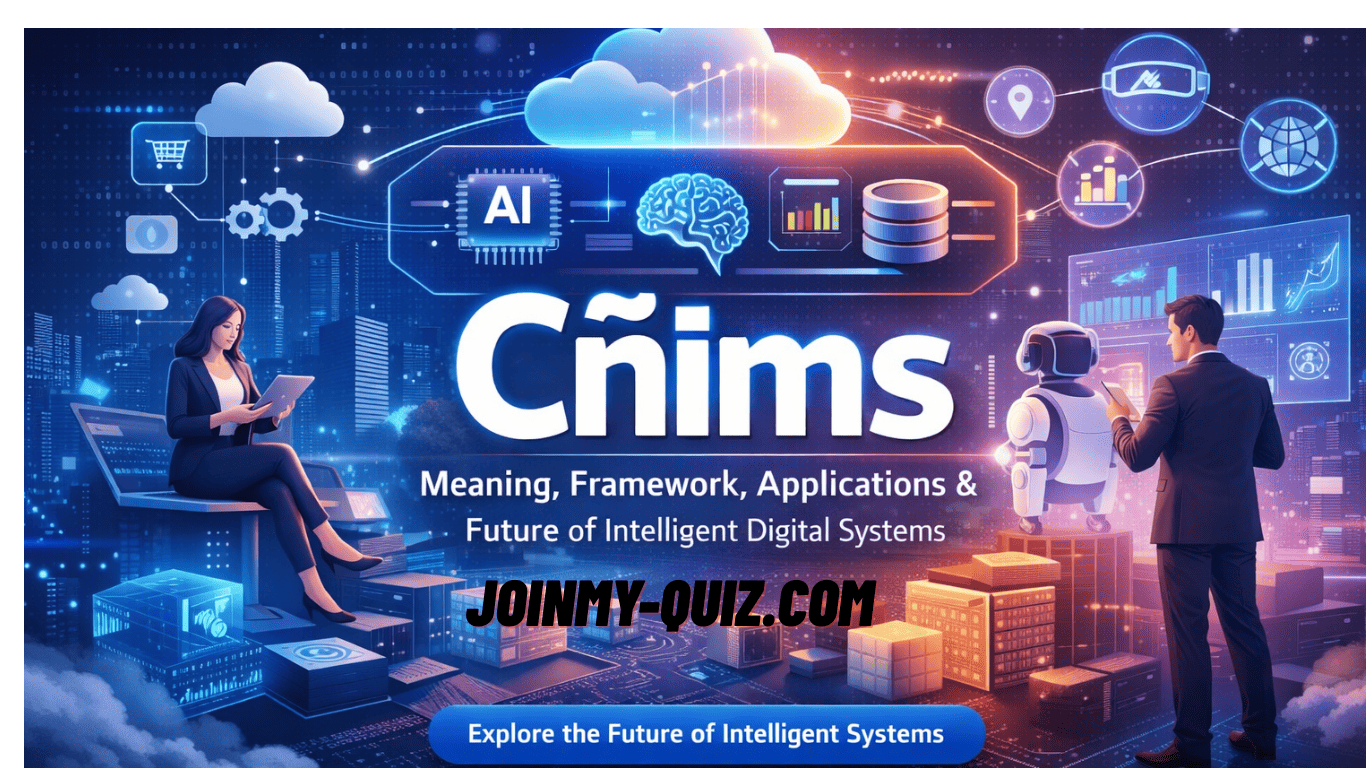
Cñims – Meaning, Framework, Applications, and Future of Intelligent Digital Systems
Introduction to Cñims
In today’s rapidly evolving digital environment, businesses must adapt to increasingly complex customer expectations and data ecosystems. Cñims has emerged as a revolutionary digital framework that helps organizations manage, analyze, and utilize information more intelligently. By combining cloud-native infrastructure, artificial intelligence, and advanced analytics, cñims transforms raw data into actionable business intelligence.
Modern organizations face challenges such as information overload, fragmented systems, and declining customer engagement. Cñims addresses these issues by enabling real-time data processing, personalized interactions, and automated decision-making. This framework plays a crucial role in enhancing personalization, improving workflow automation, and supporting scalable business growth.
For marketing teams, cñims enables hyper-personalized campaigns. operations, it delivers predictive insights. For leadership, it supports strategic planning. The purpose of this article is to provide a comprehensive understanding of cñi ms, including its structure, benefits, applications, and future potential. By the end, readers will gain practical knowledge to leverage cñims for digital transformation and sustainable success.
What Is Cñims?
2.1 Understanding the Concept
Cñims refers to an intelligent digital system designed to integrate data management, analytics, and personalization into a unified platform. In digital marketing and enterprise environments, it acts as a bridge between data collection and actionable insights.
Powered by artificial intelligence, machine learning, and big data analytics, cñims continuously learns from user behavior and system interactions. Instead of relying on static reports, organizations gain dynamic dashboards and predictive models. This enables proactive decision-making rather than reactive problem-solving.
One major shift introduced by cñi ms is the transformation of users from passive consumers into active participants. Customers interact with personalized tools, recommendation engines, and dynamic content. Employees engage with adaptive systems that respond to their workflows. This creates a more responsive and collaborative digital ecosystem.
2.2 Meaning and Terminology
Cñims stands for Cognitive, Networked, and Integrated Management Systems.
- Cognitive: Uses AI to analyze, classify, and interpret data.
- Networked: Connects data sources across departments and locations.
- Integrated: Unifies enterprise systems into one platform.
Its cloud-native architecture allows flexible scaling, high availability, and remote accessibility. Unlike traditional systems, cñims operates as an intelligent infrastructure that adapts to changing business demands.
By creating a unified data ecosystem, organizations eliminate silos and gain a single source of truth. This improves collaboration, transparency, and operational accuracy.
Evolution of Cñims and Data Management
3.1 Traditional Information Systems
Early businesses relied on physical filing systems that required manual storage and retrieval. These systems were slow, error-prone, and difficult to scale.
Later, on-premise servers digitized data storage, enabling faster access but requiring expensive maintenance. Basic cloud storage improved flexibility but lacked advanced intelligence.
These systems focused mainly on storage rather than insight generation.
3.2 Big Data and Cloud Transformation
With the rise of digital platforms, organizations began generating massive datasets. This introduced the challenges of volume, velocity, and variety. Traditional databases struggled to manage unstructured data from social media, IoT devices, and mobile applications.
Data lakes and NoSQL databases emerged to handle this complexity. However, they still required advanced tools to extract meaningful insights.
3.3 Emergence of Cñims
Cñims evolved as a response to these limitations. It integrates AI-powered analytics, automated classification, and cloud scalability. Data is no longer static—it becomes predictive and adaptive.
Organizations move from data accumulation to data mastery. Information becomes a strategic asset rather than a storage burden.
Importance of Cñims in the Digital Era
Cñims plays a vital role in addressing modern business challenges. Many organizations struggle with declining engagement, low retention, and generic communication. Cñi ms enables hyper-personalization that aligns content with individual user needs.
It enhances decision-making through real-time analytics and predictive modeling. Operational efficiency improves as manual processes become automated. Departments collaborate through shared data platforms.
Most importantly, cñims supports digital transformation by aligning technology, people, and processes into a cohesive system.
5. Key Components of a Cñims Platform
5.1 Ingestion Layer
The ingestion layer gathers data from websites, CRM systems, IoT devices, APIs, and cloud platforms. It standardizes formats and ensures quality.
5.2 Processing Core
This core cleans, deduplicates, and tags data. AI algorithms analyze patterns and relationships, enabling deeper insights.
5.3 Storage Fabric
Distributed cloud storage supports structured and unstructured data. It ensures redundancy, security, and high availability.
5.4 Modular Architecture
Cñims uses a modular design where components can be upgraded independently. This ensures scalability and system resilience.
5.5 Integration Layer
This layer connects enterprise tools such as ERP and CRM systems. It enables real-time synchronization and unified reporting.
6. Artificial Intelligence and Machine Learning in Cñims
6.1 AI-Powered Features
AI enables automated classification, metadata creation, and anomaly detection. This reduces manual effort and improves accuracy.
6.2 Predictive Analytics
Cñims forecasts demand, identifies trends, and evaluates risks. Businesses can prepare for future challenges proactively.
6.3 Workflow Automation
Documents are routed automatically. Alerts notify stakeholders of anomalies. Processes are optimized for efficiency.
6.4 Semantic SEO Optimization
Cñims clusters content semantically, manages metadata, and aligns information with search intent. This improves organic visibility and internal linking.
7. Key Features of Cñims
Cñims offers real-time processing, cloud scalability, adaptive learning, and user-friendly dashboards. Mobile access enables remote management, while role-based personalization ensures relevant data access.
These features make cñi ms accessible to both technical and non-technical users.
8. Benefits of Cñims for Businesses
8.1 Strategic Benefits
Organizations gain predictive insights, competitive advantage, and faster responses to market changes.
8.2 Operational Benefits
Automation reduces costs, accelerates reporting, and improves productivity.
8.3 Marketing Benefits
Personalized campaigns, higher engagement, and improved retention drive revenue growth.
8.4 Digital Presence Benefits
SEO optimization and enhanced UX improve online visibility and brand credibility.
9. Industry Applications of Cñims
9.1 Healthcare
Secure patient records, telemedicine integration, and research analytics improve care quality.
9.2 Finance and Fintech
Fraud detection, compliance automation, and customer profiling enhance security and trust.
9.3 Retail and E-Commerce
Demand forecasting, personalized recommendations, and inventory optimization increase profitability.
9.4 Manufacturing
Predictive maintenance and supply chain monitoring reduce downtime.
9.5 Digital Marketing
Interactive campaigns and gamification improve user engagement.
10. How to Implement Cñims for Your Business
Organizations should define objectives, audit systems, cleanse data, adopt suitable technologies, and train employees. A phased rollout minimizes risks and ensures smooth adoption.
11. Best Practices for Maximizing Cñims
Businesses should leverage predictive analytics, combine creativity with data, prioritize UX, maintain transparency, ensure compliance, and monitor performance continuously.
12. Examples and Case Studies of Cñims
Personalized e-commerce platforms increase sales. Interactive email campaigns double engagement. Gamified fitness apps boost retention. These examples demonstrate the versatility of cñims.
13. Challenges in Adopting Cñims
Resistance to change, integration complexity, bandwidth limitations, vendor lock-in, and regulatory compliance are common obstacles. Proper planning reduces these risks.
14. ROI and Cost-Benefit Analysis
Compared to legacy systems, cñi ms offers lower setup costs, instant scalability, stronger security, and higher long-term returns. Automation reduces dependence on large IT teams.
15. Future Trends in Cñims Technology
Autonomous systems will generate reports automatically. Voice and AR will enhance interactions. Real-time personalization will become standard. Quantum computing, blockchain, and generative AI will strengthen security and creativity.
16. Selecting the Right Cñims Provider
Organizations should evaluate API compatibility, uptime guarantees, customer support, scalability, file compatibility, and security certifications before selecting a provider.
17. How Cñims Are Redefining Digital Marketing and Data Management
Cñims enables personalized storytelling, customer-centric ecosystems, intelligent automation, transparent data practices, and experience-driven marketing strategies.
18. FAQs About Cñims
What is cñims?
Cñi ms is an intelligent framework that integrates AI, analytics, and cloud systems.
Who can benefit?
Businesses of all sizes and industries.
Is it suitable for small businesses?
Yes, scalable models make adoption affordable.
What technologies support it?
AI, machine learning, cloud computing, and analytics.
How secure is cñims?
It uses encryption, access controls, and compliance standards.
What is the cost?
Costs vary based on scale and features.
19. Related Topics
- SumoSearch and digital intelligence
- AI-powered CRM systems
- Cloud analytics platforms
- Marketing automation tools
20. Conclusion
Cñims represents the future of intelligent digital systems. By integrating cloud-native architecture, artificial intelligence, and centralized governance, it empowers organizations to convert data into strategic intelligence.
From predictive analytics and workflow automation to enhanced security and semantic SEO, cñims supports smarter, faster, and more secure operations. Although implementation requires careful planning and change management, the long-term benefits far outweigh the challenges.
Businesses that adopt cñims today position themselves for sustained growth, innovation, and competitiveness. Now is the time to embrace intelligent data management and unlock the full potential of digital transformation.