
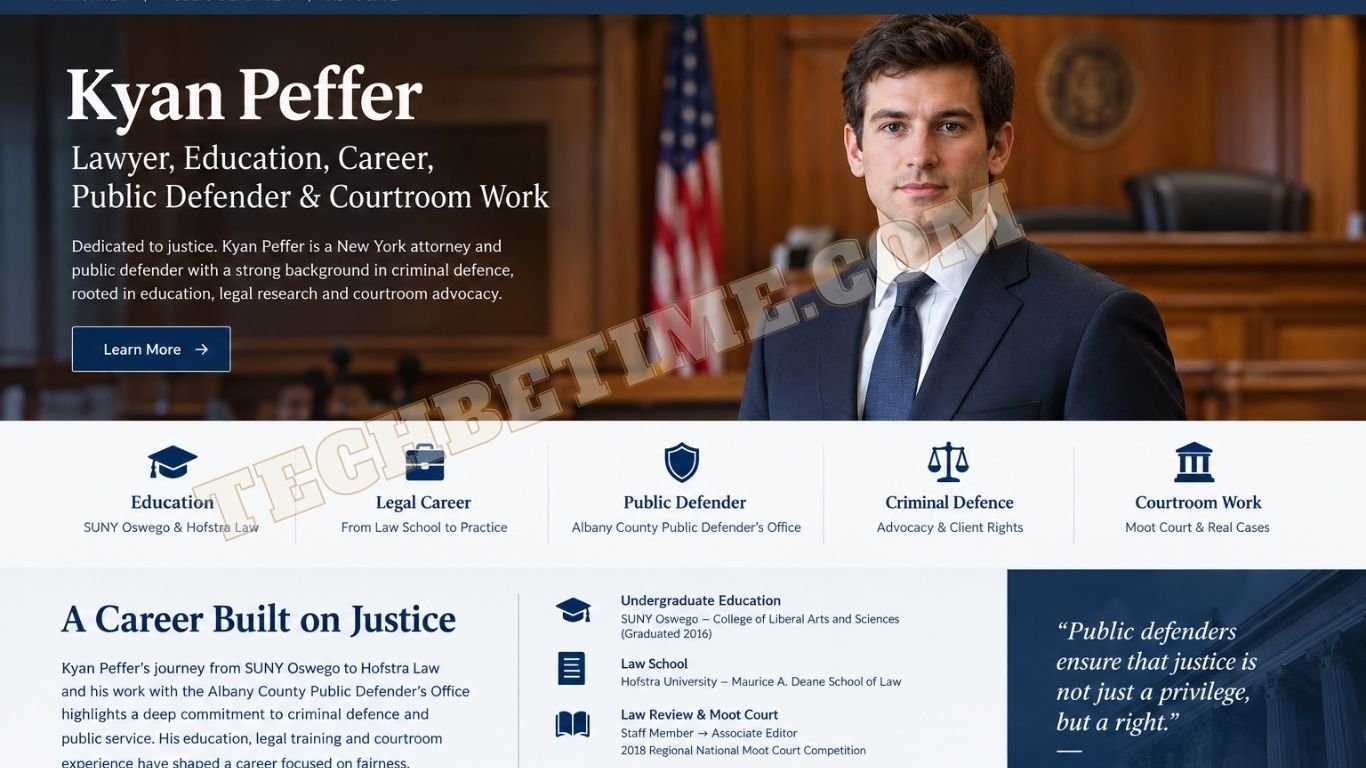
Kyan Peffer – Lawyer, Education, Career, Public Defender & Courtroom Work
Kyan Peffer is a New York attorney whose professional career is associated with criminal defence and public legal representation. Public records connect him with the Albany County Public Defender’s Office, while educational records show an academic path through the State University of New York College at Oswego and the Maurice A. Deane School of Law at Hofstra University. His law-school experience also included participation in the Hofstra Law Review and competitive moot court.
Unlike public figures whose careers are heavily covered by the media, Peffer has a relatively limited public profile. The information that can be reliably documented is primarily related to his education, legal training and courtroom work. This makes his professional record more useful for understanding Kyan Peffer than unverified claims about his personal life.
His career is particularly relevant because public defenders occupy an important position in the American legal system. They represent eligible people who cannot afford private legal counsel and help protect defendants’ rights throughout criminal proceedings. Albany County describes its Public Defender’s Office as providing representation in criminal and family court matters and at different stages of legal proceedings.
Who Is Kyan Peffer?
Kyan Peffer is an attorney associated with the Albany County Public Defender’s Office in Albany, New York. His professional work is connected to criminal defence, where attorneys represent people accused of crimes and ensure that the legal process is followed properly.
Available professional information identifies Peffer with the Maurice A. Deane School of Law at Hofstra University and the Albany County Public Defender. His professional profile therefore provides a clearer picture of his career than information about his private life.
The role of a public defender is different from the way lawyers are sometimes portrayed in television or popular media. A defence attorney does not decide whether a client is guilty. Instead, the lawyer represents the client, examines the government’s evidence, raises appropriate legal arguments and works to protect the client’s rights.
Albany County’s public-defender system serves eligible people who require representation in criminal and other qualifying proceedings. County documents describe representation extending from arraignment through later stages of a criminal matter and, where appropriate, appeals.
For that reason, the most useful way to understand Kyan Peffer lawyer or Kyan Peffer attorney searches is through his professional role. His available record points to a career built around legal advocacy, courtroom preparation and public defence rather than a broad entertainment or media profile.
Kyan Peffer as a Criminal Defence Attorney
Criminal defence involves much more than appearing before a judge. Attorneys must understand the charges against a client, examine evidence, review applicable statutes and case law, communicate with the client and determine which legal issues need to be addressed.
A defence lawyer may challenge evidence, question witnesses, negotiate with prosecutors, make motions and represent the client during hearings or trial. The exact work depends on the facts of each case.
For a public defender, these responsibilities are performed for clients who qualify for publicly funded representation. Albany County describes its office as representing eligible individuals in criminal proceedings and providing attorneys throughout different stages of a case.
This provides important context for Kyan Peffer criminal defence searches. His work should be understood as part of a broader public-defence system rather than simply as a collection of courtroom appearances.
Kyan Peffer’s Early Education
Kyan Peffer’s undergraduate education is connected to the State University of New York College at Oswego, commonly known as SUNY Oswego. A December 2016 SUNY commencement record lists Kyan Robertson Peffer among graduates in the College of Liberal Arts and Sciences.
An undergraduate education can provide an important foundation for later legal study. Although a particular undergraduate degree does not automatically determine a person’s legal speciality, university study generally requires students to develop abilities in reading, research, writing, analysis and structured communication. These skills are also central to legal education.
The SUNY Oswego record is useful because it provides an institutional source for the connection between Peffer and the university. It does not, however, provide a complete biography of his undergraduate years. It should therefore not be used to make unsupported claims about his student activities, personal interests or academic performance beyond what the record establishes.
The transition from undergraduate study to law school represents the next documented stage of Peffer’s education. His later activities at Hofstra show a growing emphasis on legal writing, research and advocacy.
For readers searching Kyan Peffer SUNY Oswego, the most reliable takeaway is that his name appears in the university’s December 2016 commencement documentation. This gives a documented starting point for the educational path that later led him into legal training and professional practice.
Studying Law at Hofstra University
After his undergraduate education, Kyan Peffer attended the Maurice A. Deane School of Law at Hofstra University. His law-school years provide some of the clearest information about his development as a future attorney.
Law school involves intensive study of legal doctrine, judicial decisions, statutes, procedure and legal reasoning. Students also commonly participate in activities that develop practical skills, including journals, moot court, clinics and other advocacy programmes.
Peffer’s Hofstra record is particularly notable because it includes both legal-publication experience and moot-court participation. Those activities complement traditional classroom education by requiring students to work with legal authorities and communicate legal arguments in structured formats.
His professional profile identifies Hofstra as his law school, and official Hofstra Law Review documents provide additional evidence of his participation in the school’s legal journal.
This educational background is relevant to understanding Kyan Peffer Hofstra Law searches because it shows that his legal preparation included more than simply completing a degree. His activities exposed him to legal research, editing, written advocacy and oral argument.
Kyan Peffer and the Hofstra Law Review
One documented part of Peffer’s Hofstra experience was his involvement with the Hofstra Law Review.
The Volume 47 masthead lists Kyan R. Peffer among the journal’s staff. A subsequent Volume 48 masthead identifies him as an Associate Editor.
A law review is a student-edited legal publication. Participation generally requires careful attention to legal sources, citations, writing quality and substantive arguments. Editorial responsibilities can expose law students to the detailed process of reviewing and refining legal scholarship.
Peffer’s progression from a staff listing to an associate-editor listing is a documented part of his law-school record. However, the available mastheads do not establish which individual articles or assignments he personally edited, so it would be inappropriate to attribute specific publications to him without additional evidence.
The experience nevertheless provides useful context for his professional development. Criminal defence attorneys frequently need to read statutes, judicial opinions and other legal materials closely. They must then turn that research into practical arguments that can be understood by judges, clients and opposing counsel.
Therefore, the Kyan Peffer Law Review connection is relevant not because it proves a particular legal speciality, but because it documents his participation in a demanding legal-writing and research environment during law school.
Kyan Peffer’s Moot Court Experience
Kyan Peffer also participated in competitive moot court while attending Hofstra Law.
The New York City Bar Association reported that Hofstra’s team of Alexandra Davidson, Kyan Peffer and Joseph Taglienti received the Runner-Up Brief award during the regional rounds of the 69th Annual National Moot Court Competition in November 2018.
Moot court is designed to simulate aspects of appellate advocacy. Students research legal issues, prepare written briefs and present arguments before judges. They may also need to respond to challenging questions during oral argument.
This type of exercise develops several skills that can be useful to practicing lawyers. Students must understand a legal problem, identify relevant authority, construct a logical position and defend that position under questioning.
The 2018 result should be described accurately. The recognition was awarded to the Hofstra team’s brief, not specifically to Peffer as an individual author. The official New York City Bar account identifies Peffer as one of the three members of the team.
For someone later working in criminal defence, experience with structured legal argument can provide useful preparation. Criminal litigation is different from appellate moot court, but both require attorneys to analyse legal questions and communicate arguments clearly.
Thus, the Kyan Peffer moot court record is a meaningful part of his law-school background without requiring claims that go beyond the documented competition result.
Kyan Peffer’s Legal Career
After completing his legal education, Peffer moved into professional legal practice in New York. Public professional information connects his career with legal-aid work and later public defence before his current association with the Albany County Public Defender’s Office. A professional profile lists previous work with the Legal Aid Society of Nassau County and earlier legal internships, while his public LinkedIn profile identifies the Albany County Public Defender as his employer.
A legal career in criminal defence can involve substantial preparation outside the courtroom. Attorneys may interview clients, examine discovery materials, research legal questions, prepare motions and communicate with prosecutors before a hearing or trial occurs.
Public defence also differs from private practice in the way clients are assigned and the broader public-service purpose of the work. Albany County states that its Public Defender’s Office represents eligible people who cannot afford legal counsel and handles proceedings across several courts.
The available record therefore presents Kyan Peffer career as a progression from undergraduate study and law school into practical legal work, including public-interest and criminal-defence responsibilities.
It is important not to turn this documented career path into assumptions about Peffer’s personal motivations. Public records can establish where a person studied and worked, but they do not necessarily establish why an individual selected a particular career. The strongest description is therefore based on the roles and activities that can actually be documented.
Kyan Peffer and the Albany County Public Defender’s Office
Kyan Peffer is associated with the Albany County Public Defender’s Office, a government legal-service office serving eligible clients in Albany County.
Albany County explains that its Public Defender’s Office provides legal representation to people who cannot afford an attorney in qualifying criminal and family court proceedings. Its 2019 budget documentation states that public defenders represent clients at different stages of criminal proceedings, beginning with arraignment and continuing through disposition and, when appropriate, appeals.
More recent county information likewise identifies court representation as a service of the Public Defender’s Office for eligible individuals involved in criminal and family court matters.
The office’s work can involve misdemeanor matters, felony cases, court appearances, legal research, client counselling, negotiations and trials. A current Albany County recruitment description for assistant public defenders also highlights client-centred representation, collaboration with investigators and mitigation staff, and strong written and oral advocacy.
This helps explain why searches for Kyan Peffer Albany County and Kyan Peffer public defender often lead to information about criminal defence. His professional role places him within a system designed to provide legal representation to eligible people who might otherwise be unable to retain private counsel.
What Does a Public Defender Do?
A public defender is a lawyer who represents eligible defendants who cannot afford private legal representation. The attorney’s responsibilities can begin at an early stage of a criminal case and continue through hearings, negotiations, trial and potentially appeals.
The Albany County Public Defender’s Office describes representation at multiple stages of criminal proceedings. Its official documentation explains that attorneys represent clients from arraignment through final disposition and, when appropriate, appellate proceedings.
In practical terms, a public defender may review police reports and other evidence, interview clients, research applicable law, prepare motions, negotiate with prosecutors, cross-examine witnesses and make arguments before a judge or jury.
The attorney must also communicate with the client. Criminal cases can involve unfamiliar terminology and complicated procedures, so explaining what is happening and what legal options exist is an important part of representation.
Public defenders also work within professional rules governing confidentiality, conflicts of interest and advocacy. They do not determine guilt. Their role is to provide legal representation and ensure that the client’s rights are protected through the legal process.
For Kyan Peffer public defender searches, this broader explanation is important because it puts his professional role into context. His work is part of a larger institutional system rather than an isolated legal position.
Why Public Defence Matters
Public defence is an important component of the American criminal justice system because legal representation should not depend entirely on whether an accused person can afford a private lawyer.
Albany County’s own public-defender materials state that the office represents people who cannot afford legal counsel and that the right to counsel is protected by the United States and New York State Constitutions.
The practical importance of this role can be seen in the range of work performed by public defenders. They may represent clients at arraignment, negotiate cases, challenge evidence, conduct hearings and defend clients at trial.
The system also involves more than courtroom advocacy. County materials describe the need for attorneys to have time to prepare cases and work with clients until their matters are resolved.
Public defenders therefore contribute to the adversarial legal process by testing the prosecution’s case and presenting the defence position. Their work helps ensure that criminal proceedings involve legal representation on both sides.
For an attorney such as Kyan Peffer, public defence provides a professional setting where legal research, communication, advocacy and case preparation are applied directly to individual cases.
Kyan Peffer’s Documented Courtroom Work
One of the clearest publicly documented examples of Kyan Peffer’s courtroom work is his participation in the defence of Curtis Reliford in Albany County.
An official Albany County District Attorney’s Office release dated January 7, 2026, identified Peffer and fellow public defender Matthew Alpern as Reliford’s defence team in a criminal trial. The case involved allegations arising from a December 2024 incident at an Albany gas station.
The prosecution presented multiple witnesses and surveillance footage. According to the county release, the defence did not call witnesses but used cross-examination to maintain that Reliford intended to attack the victim but did not intend to kill him.
The jury found Reliford not guilty of attempted murder but guilty of attempted assault in the first degree and assault in the second degree.
This case is useful for understanding Kyan Peffer courtroom work, but it should not be presented as evidence that Peffer alone determined the verdict. He was one of two public defenders on the defence team, and the jury made the final decision after considering the evidence and arguments presented during the trial.
Kyan Peffer and the Curtis Reliford Case
The Curtis Reliford case is one of the most clearly documented examples of Peffer’s involvement in a criminal proceeding.
According to the official Albany County account, Reliford faced charges including attempted murder and assault after an altercation and stabbing at an Albany Exxon station in December 2024. The prosecution presented eight witnesses, including police personnel, a store employee and medical personnel, and also presented surveillance footage.
Peffer and Matthew Alpern represented Reliford as public defenders. The defence did not call witnesses but challenged the prosecution’s case through cross-examination and focused on the distinction between intending to attack someone and intending to kill that person.
The jury ultimately rejected the attempted-murder charge while finding Reliford guilty of attempted assault in the first degree and assault in the second degree.
This distinction is important when writing about the Kyan Peffer Curtis Reliford case. A factual article should describe what the official record says happened without claiming that the verdict was caused solely by Peffer. Trial outcomes result from evidence, legal arguments, jury deliberations and the applicable law.
Why Intent Was Important in the Case
Intent is an important concept in many criminal cases because different offences can require proof of different mental states.
In simple terms, a prosecution may need to establish not only that a defendant performed a particular act but also that the defendant possessed the mental state required by the specific offence charged. The precise legal requirements depend on the statute and charge involved.
The Reliford trial illustrates this distinction. The Albany County District Attorney’s Office reported that the defence argued Reliford intended to attack the victim but did not intend to kill him. The jury subsequently found him not guilty of attempted murder while convicting him of two assault-related offences.
That outcome demonstrates why criminal defence attorneys carefully examine the elements of individual charges. A defence argument may focus on whether the prosecution proved every required element beyond the applicable legal standard.
It is also important to separate the legal issue from assumptions about what actually happened beyond the verdict. The official account provides the prosecution’s description of the incident and the defence position, while the jury’s verdict provides the formal result on the charges.
For readers interested in Peffer’s courtroom work, the case therefore offers a concrete example of defence counsel addressing the legal distinction between an alleged act and the mental state required for a particular offence.
Legal Research and Preparation in Criminal Defence
Much of a criminal defence attorney’s work takes place before a courtroom appearance.
A lawyer may need to examine police reports, surveillance footage, witness statements, medical records and other discovery materials. The attorney then identifies relevant factual and legal questions and determines how those issues should be addressed.
Legal research is another major component. Defence lawyers may study statutes, prior judicial decisions, procedural rules and constitutional principles. They use that research to prepare motions, arguments and responses to prosecution positions.
The skills developed through law school activities can be relevant here. Peffer’s involvement with the Hofstra Law Review provides a documented connection to legal research and editing, while his moot court participation demonstrates experience with written and oral legal argument.
However, academic activities should not be presented as proof of exactly how Peffer handles every current case. Instead, they provide context for the professional skills associated with legal practice.
Criminal cases also require organisation. Attorneys may have multiple hearings and deadlines at the same time. They need to maintain case files, communicate with clients and prepare arguments while responding to developments in individual cases.
This preparation is especially important in public defence, where lawyers may represent clients at different stages of the criminal process.
Working With Clients as a Public Defender
Client communication is one of the less visible but important parts of criminal defence.
A person facing criminal charges may not understand court terminology, procedural deadlines or the possible consequences of different decisions. The attorney therefore needs to explain the situation clearly and help the client understand the legal process.
Public defenders may meet clients before arraignment, hearings, conferences or trials. They may discuss evidence, possible legal strategies, plea negotiations and other case-related decisions. The exact communication required depends on the circumstances of each case.
Albany County’s public-defender materials emphasise that attorneys are expected not only to appear in court but also to have time to prepare cases and work with clients until matters are resolved.
Client communication also involves professional confidentiality and ethical responsibilities. A lawyer must handle sensitive case information appropriately and represent the client’s legal interests within the rules governing the profession.
For someone working in public defence, communication can be particularly important because clients may be unfamiliar with the justice system. Clear explanations can help clients understand what a charge means, what will happen next and which decisions require their attention.
Therefore, Kyan Peffer attorney searches should not focus exclusively on courtroom appearances. Public-defender work also includes the preparation, consultation and communication that happen away from the courtroom.
Professional Skills Associated With Kyan Peffer’s Career
The documented stages of Peffer’s education and professional work highlight several skills relevant to legal practice.
Legal research is essential because attorneys need to identify statutes, court decisions and procedural rules relevant to their cases. Peffer’s Hofstra Law Review involvement provides documented experience in a setting centred on legal scholarship and editorial work.
Written advocacy is another important skill. Lawyers routinely prepare motions, briefs, memoranda and other written submissions. His moot court experience also involved a written brief that received runner-up recognition at the regional competition.
Oral advocacy is important when attorneys appear before judges or juries. Moot court provides one form of training in responding to questions and presenting legal arguments.
Evidence analysis is central to criminal defence. Attorneys need to understand what evidence exists, how it was obtained and what it can or cannot establish.
Client communication is equally important. A lawyer must be able to explain legal issues clearly while maintaining professional confidentiality.
Case preparation and organisation allow attorneys to manage hearings, deadlines, evidence and legal arguments.
These skills should be viewed as characteristics associated with the profession rather than as an unsupported assessment of Peffer’s personal abilities. His documented education and roles show exposure to these areas, while individual performance in particular cases should be assessed only from reliable case records.
Why People Search for Kyan Peffer
Search interest in Kyan Peffer appears to be connected primarily with his legal career, educational background and appearances in court-related records.
People may encounter his name while researching an Albany County criminal case, looking for information about a defence attorney or examining the professionals involved in a court proceeding. His name can also attract searches related to Hofstra Law and his earlier educational background.
The Curtis Reliford case is one example where Peffer’s name appears in an official county account of a criminal trial.
Other searches may focus on phrases such as Kyan Peffer education, Kyan Peffer Hofstra Law, Kyan Peffer public defender or Kyan Peffer Albany County. These queries reflect different parts of the same professional profile.
Because Peffer does not have an extensive celebrity-style public biography, reliable institutional records are especially valuable. Educational records, official court-related releases and professional profiles can provide useful information without requiring speculation.
Readers researching an attorney should also distinguish between an attorney’s role in a case and the conduct alleged against a represented defendant. A defence lawyer’s representation of a person does not mean that the lawyer is responsible for or agrees with the allegations against that client.
Kyan Peffer’s Public Profile and Personal Information
Public information about Kyan Peffer is much stronger in relation to his professional career than his personal life.
Institutional and professional sources document his education, law-school activities and legal work. These records provide useful information about his professional development without requiring claims about his private circumstances.
There is limited reliable information establishing personal details such as his exact age, family relationships, childhood or finances. Those subjects should not be presented as established facts simply because they may appear on low-quality biography or people-search websites.
This distinction is particularly important for online biography articles. Search engines can surface many pages containing repeated information, but repetition does not necessarily make a claim accurate. A responsible article should prioritise primary or institutional sources where possible.
For Kyan Peffer personal information, the appropriate approach is therefore to acknowledge the limits of the public record. Readers can learn substantially about his education and career without needing unsupported information about his private life.
This also makes the article more useful. Instead of filling space with unverified biography details, it focuses on information that can actually help readers understand who Peffer is professionally, what training he received and what type of legal work he performs.
What His Career Shows
Kyan Peffer’s documented professional path can be broadly understood as a progression from undergraduate education to law school, legal advocacy activities and professional defence work.
His name appears in SUNY Oswego’s December 2016 commencement record. He subsequently attended Hofstra Law, where he was listed with the Hofstra Law Review and participated in the 2018 National Moot Court Competition.
Those law-school experiences provided exposure to different aspects of legal practice. Law review involved a legal publication environment, while moot court involved structured written and oral advocacy.
His later professional work connects him with public defence in Albany County. His documented participation in the Curtis Reliford trial provides a concrete example of criminal courtroom work.
The overall career path therefore illustrates how legal education can progress into practical advocacy. It also shows the difference between studying legal concepts and applying those concepts in actual cases.
Most importantly, the available record supports describing Peffer through his professional work rather than through speculation. His public profile is best understood through the institutions, legal activities and cases that can be independently documented.
Conclusion
Kyan Peffer is a New York attorney whose documented career is closely connected with criminal defence and public legal representation. His educational background includes undergraduate study at SUNY Oswego and legal education at Hofstra University’s Maurice A. Deane School of Law. SUNY Oswego’s 2016 commencement record lists Kyan Robertson Peffer among graduates of the College of Liberal Arts and Sciences.
At Hofstra, Peffer was listed as a staff member of the Hofstra Law Review and later as an Associate Editor. He also participated in the 2018 regional National Moot Court Competition as part of a Hofstra team that received the Runner-Up Brief award.
His professional career later became associated with the Albany County Public Defender’s Office. That office provides legal representation to eligible people who cannot afford private counsel and represents clients throughout different stages of qualifying proceedings.
The January 2026 Curtis Reliford trial provides a publicly documented example of Peffer’s courtroom work. He and Matthew Alpern represented Reliford, with the defence challenging the attempted-murder allegation through cross-examination and argument concerning intent. The jury ultimately found Reliford not guilty of attempted murder while returning guilty verdicts on two assault-related charges.
Overall, the reliable public record presents Kyan Peffer primarily as a practising attorney whose career has developed through legal education, advocacy training and public-defender work. Information about his private life is comparatively limit, so a responsible biography should keep its focus on documented professional facts.
Frequently Asked Questions About Kyan Peffer
Who is Kyan Peffer?
Kyan Peffer is a New York attorney associat with the Albany County Public Defender’s Office. His document professional work is connect with criminal defence and public legal representation. His education includes SUNY Oswego and Hofstra University’s Maurice A. Deane School of Law.
Where does Kyan Peffer work?
Public professional information identifies Kyan Peffer with the Albany County Public Defender’s Office in Albany, New York. The office provides legal representation to eligible individuals involved in qualifying criminal and family court matters.
Where did Kyan Peffer study?
His undergraduate education is connect to the State University of New York College at Oswego. A December 2016 SUNY commencement record lists Kyan Robertson Peffer among graduates. He later attended the Maurice A. Deane School of Law at Hofstra University.
What type of law does Kyan Peffer practise?
His document professional role is connected primarily with criminal defence and public defence. His work with the Albany County Public Defender’s Office places him in a legal environment involving representation of eligible defendants in criminal proceedings.
Did Kyan Peffer participate in moot court?
Yes. The New York City Bar Association reported that Kyan Peffer was part of a three-person Hofstra team with Alexandra Davidson and Joseph Taglienti in the 2018 regional rounds of the National Moot Court Competition. The team’s brief received the Runner-Up Brief award.
Was Kyan Peffer involved in the Curtis Reliford case?
Yes. An official Albany County release identified Kyan Peffer and Matthew Alpern as the public defenders representing Curtis Reliford during the January 2026 trial. The defence challenged the attempted-murder allegation, and the jury found Reliford not guilty of attempted murder while finding him guilty of attempted assault in the first degree and assault in the second degree.
Is Kyan Peffer’s personal information publicly available?
Some professional information is publicly document, but reliable information about his private life is much more limited. His education, legal activities and professional roles can be support through institutional and professional records. Unsupport claims about family, relationships, finances or other private matters should not be treat as establish facts.
What is the Albany County Public Defender’s Office?
The Albany County Public Defender’s Office provides legal representation to eligible people who cannot afford private legal counsel. County materials state that the office represents clients in qualifying criminal proceedings from arraignment through later stages and, where appropriate, appeals.