Snapjotz.com Review: Features, Safety, Website Purpose, and Online Claims
Introduction
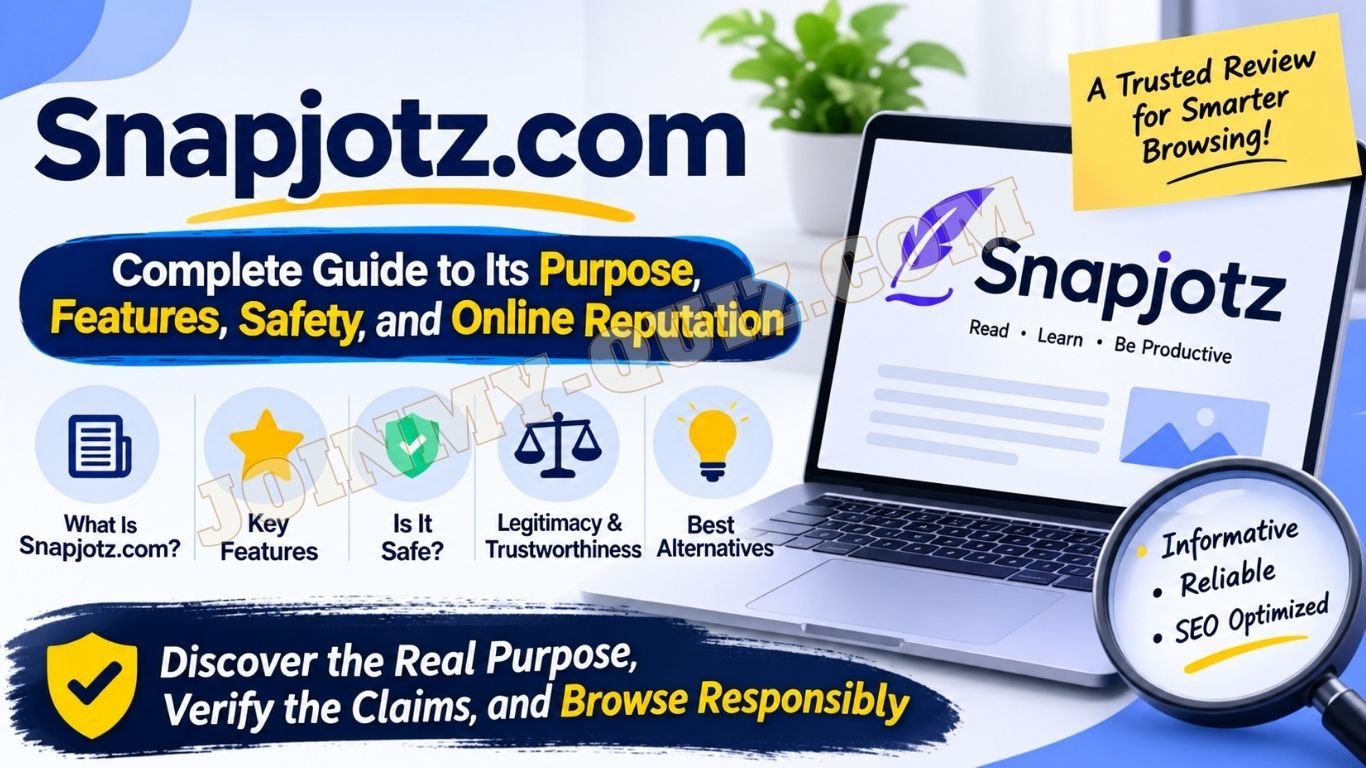
The internet is full of websites that attract attention because of their unusual names, online promotions, or claims about useful digital tools. Snapjotz.com is one such domain that raises questions about its purpose and the services visitors can expect to find. Some descriptions associate the name with note-taking, cloud-based productivity, and content sharing, while others describe it as an informational website publishing articles on technology, finance, lifestyle, and related subjects.
These different descriptions can make it difficult for visitors to determine whether Snapjotz.com is a genuine productivity application, a content-sharing service, or simply a blog. Understanding this distinction matters because each type of platform offers different features, privacy considerations, and levels of functionality.
This Snapjotz.com review examines the website’s reported purpose, potential features, online reputation, security considerations, and alternatives. It also explains how to evaluate claims about AI tools and digital services before sharing personal information or downloading software.
Important: The available descriptions of Snapjotz.com conflict with one another. Features, ownership details, user statistics, subscription prices, and security claims should therefore be treated as unverified unless confirmed through reliable sources or direct examination of the current website.
What Is Snapjotz.com?
Snapjotz.com is a domain associated in the supplied descriptions with several possible digital services. These include an informational blog, a content-sharing platform, and a proposed cloud-based note-taking workspace. However, these descriptions do not establish that all these functions exist on the same live website.
The most important distinction is between a website that publishes articles about technology and productivity and an application that allows users to create, store, organize, and synchronize their own information. An informational website can explain how digital tools work without providing those tools itself.
If the current Snapjotz.com website primarily displays articles and informational guides, visitors should evaluate it as a content publisher rather than assume it provides a complete productivity suite. If interactive tools or account features are available, those functions should be assessed separately.
The Origin and Meaning of the Snapjotz Name
The name Snapjotz may suggest quickly capturing ideas or writing down short notes. The word “snap” can imply speed, while “jot” commonly refers to recording a brief thought or piece of information. Together, these elements create an association with quick note-taking and digital organization.
However, a domain name does not prove that a website offers a particular service. Businesses and publishers sometimes select memorable names that suggest a general theme without describing their actual products precisely. A name can also remain in use after a website changes its content or business model.
For this reason, visitors should look beyond the branding when researching Snapjotz.com. The homepage, navigation menus, published content, product demonstrations, terms of service, and privacy policy provide more useful evidence about its purpose than the name alone.
A genuine online note-taking application would normally provide a way to create and edit notes, save information, retrieve previous entries, and manage an account. An informational blog would instead focus on reading articles, exploring categories, and following links to other resources.
Understanding these differences helps users avoid confusing an appealing product name with proof of an actual software service.
Snapjotz.com as an Informational Blog
One description supplied for Snapjotz.com presents it as a multi-topic informational blog covering subjects such as technology, artificial intelligence, finance, lifestyle, and everyday knowledge. Websites in this category generally aim to explain unfamiliar topics, answer common questions, and provide introductory guidance for readers.
A useful informational blog typically organizes articles under relevant categories and uses headings, internal links, and search features to help visitors find information. For example, a technology section might explain software features, while a finance section could discuss general financial concepts. Lifestyle articles may cover everyday decisions, personal interests, or practical tips.
The value of such a website depends on the quality of its content. Readers should look for clear explanations, identifiable authors, accurate information, publication dates, and references to trustworthy sources. Articles covering rapidly changing subjects, including AI and cybersecurity, deserve particular attention because outdated advice can quickly become unreliable.
The blog description should not automatically be treated as proof of the website’s current identity. Visitors should inspect the live domain to establish what it publishes today. If the site offers articles rather than interactive tools, it may still provide useful information, but its purpose differs from that of a dedicated productivity application.
Why Different Descriptions of Snapjotz.com Exist
Conflicting descriptions of Snapjotz.com may arise from outdated information, inaccurate promotional content, search-engine summaries, or confusion between a website’s name and its actual functionality. Another possibility is that descriptions refer to different stages of the domain’s development. Without reliable historical records, however, the reason for the discrepancy cannot be established conclusively.
The supplied material describes three distinct possibilities. One presents Snapjotz.com as a content-sharing service where users publish short updates and images. Another describes a cloud workspace for text, images, audio, video, and collaborative notes. A third identifies it as an informational blog.
These models are not interchangeable. A content-sharing platform emphasizes publishing and discovering user-generated posts. A note-taking application focuses on private information management, organization, and retrieval. A blog primarily delivers articles for readers to consume.
To resolve the confusion, visitors should check which functions are actually available on the current website. Look for working registration pages, interactive editing tools, upload controls, published articles, product documentation, and clear explanations of the service.
It is also important to distinguish claims repeated across websites from independently verified evidence. Several articles repeating the same statement do not necessarily constitute several independent confirmations.
What Does Snapjotz.com Actually Offer?
The services available through Snapjotz.com should be determined by inspecting its current pages rather than relying solely on descriptions found elsewhere. A website may provide informational content, interactive features, or a combination of services, but each capability requires appropriate evidence.
Website Content and Articles
If Snapjotz.com operates primarily as an informational blog, its main offering is access to published content. Readers may use such websites to explore technology explanations, learn about digital trends, understand general financial concepts, and discover lifestyle information.
The usefulness of these articles depends on their accuracy, clarity, and relevance. A well-organized article should introduce the subject, explain important concepts, provide practical examples, and distinguish established facts from opinions or uncertain claims.
Readers can evaluate content quality by examining the sources cited in an article. Official documentation is especially helpful when an article discusses software features, while recognized security organizations and relevant professional sources can help verify technical claims. For financial topics, readers should consult reputable institutions and understand the difference between general information and personalized advice.
Navigation also matters. Descriptive categories and meaningful internal links allow visitors to move between related articles without repeatedly returning to the homepage. Clear titles help users understand what a page covers before opening it.
Nevertheless, the existence of articles about AI, productivity, or digital tools does not mean Snapjotz.com supplies those services directly. Visitors looking for a functional application should check whether the website offers an actual working product, rather than assuming that related educational content is equivalent to software.
Does Snapjotz.com Provide AI Note-Taking Tools?
Claims about Snapjotz.com as an AI note-taking application require particular care. The supplied descriptions mention capabilities such as automatic transcription, AI-generated summaries, cloud synchronization, multimedia capture, and collaborative editing. These features are common in some productivity products, but their association with a domain does not establish that they are available there.
A functioning AI note-taking application generally provides an interactive environment in which users can enter or upload information and receive a defined result. Depending on the product, this might include converting speech into text, summarizing meeting notes, organizing documents, or finding information across saved material.
An informational website operates differently. It may publish articles explaining these capabilities, compare software products, or recommend tools without implementing the underlying technology itself.
To evaluate claims about Snapjotz.com, look for a working application interface, clear product documentation, understandable pricing information, and a privacy policy explaining how user content is handled. If a demonstration is available, check whether the advertised functionality can actually be tested.
Be cautious about claims involving hidden AI features, unlimited free access, secret login methods, or downloads available only through suspicious advertisements. Do not enter confidential documents, meeting recordings, or account credentials into an unverified service.
Until direct evidence establishes otherwise, it is more accurate to describe Snapjotz.com’s AI note-taking capabilities as unconfirmed than to present them as established features.
Does Snapjotz.com Support User Accounts and Content Creation?
Some descriptions characterize Snapjotz.com as a service that lets members publish content, create notes, upload files, or collaborate with other users. These functions require a different technical setup from a basic article website, so they should be verified individually.
For example, a content-sharing platform normally provides a publishing interface, account settings, and controls for managing posts. A note-taking service may include a workspace, folders, editing controls, and tools for retrieving saved information. Collaborative products may also offer invitations, permissions, or activity histories.
Visitors should look for clear explanations of account creation and determine whether registration is genuinely necessary for the functions they want to use. A registration form alone does not prove that a complete service exists, and a page describing a feature is not evidence that the feature works.
Before creating an account, review the site’s terms and privacy policy. Check what information is requested, whether the service explains its data-retention practices, and how users can close an account or request deletion of personal information.
If the website only provides articles and does not offer an account-based workspace, visitors should not expect it to store private notes or synchronize their personal files. Confirming the actual functionality first can prevent unnecessary registrations and reduce exposure of personal data.
Key Features and Website Experience
A website’s practical value depends on how well it supports its intended purpose. For an informational blog, useful qualities include readable articles, clear navigation, appropriate mobile support, and transparent advertising. For an application, visitors should also evaluate its working features, account controls, and reliability.
Website Navigation and Interface
Website navigation determines how easily visitors can find the information or functions they need. A well-designed interface typically includes a recognizable homepage, descriptive menus, readable page layouts, and links that lead to relevant destinations.
For an informational website such as the one described in the supplied blog-oriented material, useful navigation would include clear article categories, descriptive titles, and headings that allow readers to scan long pages. Search functionality can also help users locate a specific subject without browsing every section.
Readability is equally important. Text should have sufficient contrast, paragraphs should be manageable, and links should clearly indicate where they lead. Intrusive overlays, misleading buttons, or repeated pop-ups can make a site difficult to use and may increase the risk of accidental clicks.
Visitors should assess the interface directly rather than rely on unverified claims about loading times or design quality. Performance can vary depending on the device, browser, internet connection, advertising scripts, and the website’s current configuration.
A clean layout does not automatically establish that a site is trustworthy, just as an unattractive design does not prove malicious intent. Navigation is one factor among several, alongside content quality, transparency, and security practices.
Mobile and Desktop Compatibility
Mobile compatibility matters because many people access websites through smartphones rather than desktop computers. A responsive website adjusts its layout to different screen sizes, making text, menus, images, and interactive elements easier to use.
Visitors can assess Snapjotz.com on their own devices by checking whether pages fit the screen, navigation menus remain usable, and article text can be read without excessive zooming. They should also notice whether buttons are easy to tap and whether advertisements interfere with the main content.
Desktop users may benefit from wider layouts and easier navigation between multiple browser tabs. However, the basic quality standards remain the same across devices: pages should load reliably, text should be readable, and links should behave as expected.
Browser-based access can be convenient because ordinary reading usually does not require installing a dedicated application. If Snapjotz.com offers only web content, users may be able to read it through a compatible mobile browser. That does not prove that it provides a native app or offline access.
Any claim about a downloadable Snapjotz.com application should be checked through a legitimate app store or an official, verifiable publisher source. Avoid installing files from unfamiliar download pages merely because they promise a better mobile experience.
Content Categories and Discovery
Content categories help visitors understand what a website covers and locate material relevant to their interests. The supplied descriptions associate Snapjotz.com with topics such as technology, AI, finance, lifestyle, and general informational content, although the current category structure should be confirmed directly.
A useful category system groups articles around clear themes. Readers interested in technology might explore software explanations, while those researching AI could look for articles about practical applications, limitations, and responsible use. Topic-based organization makes a multi-subject website easier to navigate.
Search tools, related-article links, and descriptive headings can improve content discovery. Search engines also benefit when pages have meaningful titles and clearly structured information, but SEO optimization alone does not establish that an article is accurate.
Readers should evaluate individual pages rather than assuming that every article within a category has the same quality. Check the publication date, the expertise relevant to the subject, and whether important statements link to reliable evidence.
When researching a topic with real-world consequences, use the website as a starting point rather than the sole authority. Cross-check important information against primary sources and recognized experts before making financial, technical, or security decisions.
Advertising and External Links
Advertising is a common way for informational websites to generate revenue. Display advertisements, sponsored placements, and affiliate links can help publishers support their content, but they also create a need for clear separation between editorial information and commercial promotion.
Visitors should pay attention to the destination of each link. An article may link to an official software provider, a third-party review, an affiliate offer, or an unrelated advertising page. These destinations may have different privacy practices and security risks.
A familiar-looking advertisement does not necessarily belong to the website displaying it. Advertising networks may deliver content from external businesses, and the quality of those destinations can vary. This is why users should avoid clicking urgent-looking pop-ups that promise prizes, immediate earnings, free premium software, or exclusive AI access.
Before downloading anything, verify the publisher, file type, and official distribution source. If a page unexpectedly requests payment information, account credentials, or browser notification permissions, consider whether that request is necessary for the action being performed.
A website’s advertising practices should be assessed alongside its content quality and transparency. Ads alone do not prove that a site is unsafe, but deceptive promotions and unclear external links deserve caution.
Why Is Snapjotz.com Trending Online?
The interest in Snapjotz.com appears to be connected partly to the conflicting explanations published about the domain. Search results include descriptions of an informational blog as well as claims that the name refers to a note-taking or productivity application. This inconsistency gives readers a reason to investigate what the website actually does.
Social Media Promotions and Viral Claims
Social media platforms make it easy for unfamiliar websites to attract attention quickly. A short video might describe a website as a free AI assistant, a hidden productivity tool, or a shortcut to premium features. Such claims can encourage people to search for the domain without first checking whether the advertised functionality exists.
However, popularity and accuracy are different things. A video may receive thousands of views without providing reliable evidence about a website’s ownership, features, pricing, or safety. Some creators may misunderstand a service, repeat information from other posts, or use exaggerated language to attract clicks.
When evaluating claims about Snapjotz.com, look for evidence that can be independently checked. A credible demonstration should show the actual website address and the relevant feature in operation. Product documentation, transparent terms, and a clear privacy policy provide additional context.
Be particularly careful when a promotion promises secret AI access, free premium subscriptions, or immediate rewards in exchange for installing an unfamiliar file. Avoid supplying payment details or account passwords just to test a claim.
It is reasonable to investigate a trending website, but the decision to trust it should depend on evidence rather than engagement numbers. Treat viral content as a lead for further research, not as proof that the advertised service works.
Search Intent Mismatch
Search intent refers to what a person hopes to accomplish when entering a query into a search engine. Someone searching for “Snapjotz.com AI note-taking app” may expect an application that can save notes, transcribe recordings, or organize information. Someone searching for “Snapjotz.com review” may simply want to understand the website.
When a search result leads to an informational blog instead of an interactive application, the visitor experiences a mismatch between expectation and reality. The article may discuss productivity software without offering the software itself.
There are three important website types to distinguish:
- Informational website: Publishes articles, explanations, and educational resources.
- Web application: Provides interactive functions through a browser, such as creating documents or managing information.
- Downloadable software: Requires an installation package or app-store installation to access some or all of its functions.
Some businesses combine these models, but their existence should be demonstrated rather than assumed. A website can publish a guide to AI transcription without having any transcription technology of its own.
For Snapjotz.com, the supplied descriptions do not establish a functioning note-taking or AI workspace. Visitors seeking those capabilities should confirm their availability on the exact domain before registering or paying. Understanding search intent helps users avoid wasting time and reduces the likelihood of trusting unrelated promotional pages.
Domain Name, Branding, and User Expectations
Branding influences how people interpret unfamiliar websites. The name Snapjotz may bring to mind quick notes, snapshots, or creative ideas. Those associations are understandable, but they do not establish the website’s business model.
A domain can be used for a blog, a software product, a community, an online store, or another service. Its purpose can also change over time. Consequently, readers should distinguish between what a name suggests and what the website demonstrably provides.
The same principle applies to websites with similar spellings. A hyphenated domain or a different domain extension may belong to a separate publisher. For example, information published at snap-jotz.com should not automatically be attributed to snapjotz.com. The exact address matters whenever you evaluate features, ownership, or privacy practices.
A reliable assessment starts with the live website and then considers supporting evidence. Check its About page, contact details, product documentation, and policies. If a website claims to provide software, look for a working interface and clear information about how the service operates.
The best approach is to assess Snapjotz.com based on its observable function, not its name or online reputation alone.
Is Snapjotz.com Safe to Browse?
Safety is an important consideration when visiting unfamiliar websites. It involves more than checking whether a homepage opens successfully. Visitors should consider the site’s connection security, the behavior of advertisements, the reliability of external links, and the information requested from them.
The available descriptions do not provide sufficient evidence to guarantee that every part of Snapjotz.com, its advertisements, or any linked service is safe. That does not mean the domain is necessarily malicious. It means users should apply normal web-safety precautions and verify claims before taking risks.
Website Security and HTTPS Encryption
HTTPS protects communication between a browser and a website through encryption using TLS. When configured correctly, it helps prevent other parties from reading or modifying information while it travels between the browser and the server.
A valid HTTPS connection is useful, particularly when accessing account pages or submitting information. Visitors can check the browser’s address bar to confirm that the intended domain is being accessed over HTTPS. They should still verify the spelling of the domain because a secure connection can also be established with a misleading website.
HTTPS does not prove that a publisher is honest, that an article is accurate, or that a website’s business practices are trustworthy. A malicious website can also use an encrypted connection. The certificate primarily addresses connection security and website identity within the limits of the certificate system.
For Snapjotz.com, visitors should check the current connection in their own browser rather than rely on an older security report. Certificate status and website configuration can change. Avoid bypassing browser security warnings, particularly if a page requests a password, payment details, or other sensitive information.
A sound security assessment combines HTTPS checks with careful inspection of the page, its publisher, its policies, and any external destinations. No single indicator is enough to establish overall trustworthiness.
Malware, Phishing, and Suspicious Advertisements
Malware is software designed to perform harmful or unauthorized actions, while phishing attempts trick people into disclosing information such as passwords or financial details. Both can be encountered through deceptive downloads, misleading advertisements, or links to external websites.
When visiting Snapjotz.com, be cautious if a page displays unexpected warnings claiming that your device is infected or that you must install an update immediately. Such messages may be designed to persuade users to download unwanted software or visit an untrustworthy destination.
Other warning signs include fake prize notifications, requests to enable browser notifications to continue reading, suspicious file downloads, and login pages that imitate familiar services. Avoid entering credentials after following an unsolicited link. If a service genuinely requires authentication, navigate to its verified official address independently.
You can use reputable security services, such as Google Safe Browsing’s site-status checker, to investigate a suspicious destination. Multi-engine scanning services can also provide useful signals, although no scanner can guarantee that a website or file is harmless.
Do not interpret a clean scan as proof of complete safety. Newly created threats, deceptive business practices, and risky third-party advertisements may not be identified by automated tools.
The practical rule is simple: browse cautiously, avoid unnecessary downloads, and leave any page that pressures you into taking an unfamiliar or potentially harmful action.
Personal Information and Privacy
Privacy concerns arise whenever a website collects, processes, stores, or shares information about its visitors. Even if you only intend to read articles, a website may use cookies, analytics tools, server logs, or advertising technologies. The actual practices depend on the site’s configuration and policies.
Before creating an account or submitting information to Snapjotz.com, look for a privacy policy explaining what data is collected, why it is needed, how long it is retained, and whether it is shared with third parties. The policy should also explain available choices concerning cookies, account deletion, or privacy requests where applicable.
Provide only the information necessary for the activity you want to perform. If a website is simply displaying public articles, a request for banking information, a payment-card number, or a primary email password would be a serious reason to stop and reassess the situation.
If you use an unfamiliar service, never reuse a password from your email, banking, or other important accounts. A unique password reduces the consequences if one service experiences a data breach.
It is also wise to avoid uploading confidential work documents, private recordings, identification documents, or sensitive personal notes to a service whose data-handling practices you have not verified.
The privacy practices of Snapjotz.com cannot be established solely from descriptions published by other websites. Review the current policies directly before sharing anything beyond what is necessary.
Is Snapjotz.com Safe for Mobile Users?
Mobile users face many of the same risks as desktop visitors, but small screens can make suspicious URLs and deceptive interface elements harder to notice. Pop-ups may cover the page, download prompts may resemble system alerts, and advertisements can sometimes imitate familiar app-store buttons.
If you visit Snapjotz.com on a phone, use an updated browser and operating system. Check the complete domain before entering information, and avoid installing application packages from unfamiliar third-party sites. On Android, an APK downloaded from an unknown source should not be treated as legitimate simply because it uses the Snapjotz name.
If the website is a content blog, ordinary browsing through a mobile browser may be sufficient. You do not need to install an app just to read public articles unless there is a clearly documented and independently verifiable reason to do so.
Be cautious with permission requests. A reading website generally should not need broad access to your contacts, microphone, location, or personal files simply to display text. If you encounter an unexpected request, deny it unless there is a clear, legitimate purpose.
If a page redirects repeatedly, opens unfamiliar tabs, or downloads a file without your intention, close it and review your browser’s download list and notification settings.
These precautions do not imply that Snapjotz.com is specifically targeting mobile users. They are general practices that help protect people when visiting unfamiliar websites.
Snapjotz.com Legitimacy and Trustworthiness
The question of legitimacy depends on what a visitor expects from the website. A domain can operate as a real content publisher without being a software company, and a website can be accessible without every claim about it being accurate.
For Snapjotz.com, the central issue is the gap between descriptions of an informational publication and claims about advanced productivity software. The available material supports treating those claims cautiously unless the relevant functions can be demonstrated.
Domain Registration and Ownership Transparency
Domain registration records can provide information such as the registrar, registration dates, name servers, and certain registrant details, depending on the domain and privacy settings. ICANN’s registration lookup resources can help users investigate this information.
Some domain owners use privacy-protection services to prevent their personal contact details from appearing publicly. This is common and does not, by itself, prove that a website is fraudulent. However, limited public ownership information can make it harder for visitors to identify the organization responsible for a service.
For a website that publishes informational articles, readers can look for other accountability signals. These include an About page, a working contact method, identifiable editorial responsibilities, and clear policies governing content and user data.
If a site claims to operate a commercial software product, visitors should expect appropriate product information, terms of service, support details, and a clear explanation of the organization behind the service. The absence of one particular detail does not establish wrongdoing, but several missing or contradictory details may justify additional caution.
Any claimed registration date for Snapjotz.com should be checked against current domain-registration records. Registration history alone cannot establish the quality of a website’s content or confirm that its current operator is the original registrant.
Website Content Quality and Editorial Accountability
Content quality is one of the most useful ways to evaluate an informational website. A trustworthy article should answer the reader’s question, explain important terms, support factual claims, and make uncertainty clear rather than presenting speculation as established truth.
Readers evaluating Snapjotz.com should check whether articles identify their authors, provide meaningful publication or update dates, and cite sources that can be opened and assessed. A reference is more useful when it directly supports the statement being made instead of merely linking to a loosely related page.
Editorial transparency also matters. A website that explains how its content is created, how corrections are handled, and how sponsored material is identified gives readers more information with which to judge its reliability.
A multi-topic website may cover many subjects, but broad coverage does not guarantee specialist expertise. Articles about medicine, law, finance, and cybersecurity should be assessed against authoritative sources appropriate to each subject.
Watch for contradictory statistics, unsupported product descriptions, generic claims about safety, and statements that cannot be traced to reliable evidence. If multiple articles repeat the same unsupported claim, that repetition should not be mistaken for independent verification.
Ultimately, readers should judge each article by its evidence and usefulness. A site’s appearance, search ranking, or number of published pages cannot replace accurate sourcing and transparent editorial practices.
How to Verify Claims About Snapjotz.com
A practical way to evaluate Snapjotz.com is to separate information into four categories:
- Directly observed facts: What the current website visibly displays and what its working features actually do.
- Official statements: Information published by the site’s operator in its own documentation or policies.
- Independent evidence: Relevant findings from reputable third-party sources that can be checked independently.
- Unverified claims: Statements about features, ownership, pricing, user numbers, or security that lack adequate supporting evidence.
Start by visiting the exact domain and inspecting the homepage, article categories, About page, and contact information. If the website claims to offer an application, look for a working product interface, documentation, and clearly explained account features.
Next, verify claims that can change over time. Registration dates can be checked through domain lookup services, while potentially suspicious URLs can be investigated using reputable security tools. If a price is advertised, look for official pricing information and determine whether the page belongs to the same organization.
Be careful about confusing similarly named domains. A review of snap-jotz.com, for example, is not automatically a review of snapjotz.com. The full URL should match the subject of the claim.
Finally, record uncertainty honestly. If no reliable source establishes that a feature exists, describe it as unconfirmed rather than inventing details or treating promotional claims as facts.
This approach provides a more dependable assessment than relying on a single review, an anonymous social media post, or a website’s branding alone.
Current search results reinforce the need to distinguish the actual domain from similarly named websites. A recent article about Snapjotz.com describes an article-based publication, while another source specifically warns that snapjotz.com and snap-jotz.com are different addresses. These sources support checking the exact domain, but they do not independently establish every claim about ownership, safety, or historical traffic.
Snapjotz.com Pros and Cons
Snapjotz.com should be evaluated according to the service it actually provides. If it functions as an informational blog, its value depends on whether its articles help readers understand a topic. If visitors arrive expecting a dedicated note-taking application, the lack of confirmed productivity features becomes an important limitation.
Potential Advantages
An article-based website can be useful for readers who want to explore different topics without installing software or creating an account. If Snapjotz.com provides publicly accessible articles, visitors may be able to read them directly through a compatible browser.
A multi-topic publication can also help readers discover unfamiliar subjects. For example, someone researching technology may find related explanations about digital tools, online privacy, or emerging trends. Well-organized articles can make introductory information easier to understand.
Another potential advantage is convenience. Browser-based reading allows people to access content from different devices without manually transferring files or maintaining a separate application. This is particularly helpful when the purpose is simply to learn about a subject.
However, these advantages depend on the website’s current operation and the quality of its published material. Readers should not assume that every article is accurate or that every reported feature is available.
Potential Limitations
The main limitation is the conflicting information associated with Snapjotz.com. Descriptions of a note-taking workspace, a content-sharing service, and an informational blog suggest different purposes, making it important to verify what the domain currently offers.
Another limitation is the absence of established evidence in the supplied material that Snapjotz.com provides a dedicated AI application with transcription, synchronization, or collaboration capabilities. Users seeking these functions may need a specialist product instead.
If the website relies on third-party advertising, some external destinations may have different privacy practices and levels of reliability. Readers should distinguish advertisements from editorial content and avoid suspicious downloads.
Finally, limited information about editorial responsibility or ownership can make it harder to evaluate accountability. These uncertainties do not prove that a website is fraudulent, but they do justify checking its content, policies, and features before relying on it.
Snapjotz.com vs. AI Note-Taking and Productivity Alternatives
People searching for Snapjotz.com may actually need a tool for organizing ideas, managing documents, transcribing meetings, or maintaining a searchable knowledge base. In that situation, it helps to compare established products according to their intended uses instead of assuming that a content website provides the same functionality.
Notion
Notion is designed for organizing notes, documents, databases, projects, and shared team knowledge. Its workspace approach allows users to combine different types of information rather than keeping every project in a separate application.
It may suit students organizing coursework, freelancers managing client information, or teams maintaining project documentation. AI capabilities depend on the current product offering and subscription terms, so users should check the official documentation before purchasing a plan.
Official website: https://www.notion.com/
Otter.ai
Otter.ai focuses on speech transcription and meeting-related workflows. Depending on the current plan and supported integrations, users can explore features for turning spoken conversations into text and reviewing meeting information.
This type of service is more appropriate for people who need to work with recorded discussions than a general informational blog. Users should review recording permissions, transcription accuracy, retention policies, and consent requirements before using it for sensitive meetings.
Official website: https://otter.ai/
Obsidian
Obsidian is a note-taking and personal knowledge-management application built around linked notes. It uses local Markdown files, making it attractive to people who want their notes stored as accessible text files rather than exclusively inside a proprietary cloud workspace.
Users can connect ideas through links, organize research, and extend the application with community plugins. However, plugins may introduce additional maintenance and security considerations, so users should review them before installation. Synchronization and other optional services should be evaluated separately according to individual requirements.
Official website: https://obsidian.md/
Craft
Craft is a document and note-taking tool focused on structured writing and organized information. It can be useful for people who prefer polished documents, personal notes, and collaborative content rather than a basic collection of text files.
Its suitability depends on the features currently available for the user’s device, workflow, and subscription plan. Before moving important information into any service, review export options, synchronization behavior, privacy policies, and supported platforms.
Official website: https://www.craft.do/
Which Alternative Should You Choose?
The right choice depends on what you need to accomplish.
| Requirement | Option to investigate |
|---|---|
| Project documents and team knowledge | Notion |
| Meeting transcription and spoken notes | Otter.ai |
| Linked notes and personal knowledge management | Obsidian |
| Structured documents and polished writing | Craft |
| General information and articles | Snapjotz.com, if its current content meets your needs |
Before choosing, compare the total cost, privacy controls, offline functionality, collaboration options, export capabilities, and availability on your devices. Free tiers may have usage limits, while advanced features can require paid subscriptions.
If you need to store confidential information, pay particular attention to data retention and access controls. If you work offline frequently, verify which features remain available without an internet connection.
These alternatives serve different purposes, so they should not be treated as interchangeable. Their official product pages are the best starting points for checking current capabilities and pricing.
How to Use Snapjotz.com Responsibly
Responsible browsing means understanding what a website provides, checking the information it publishes, and avoiding unnecessary security or privacy risks. These practices are useful whether Snapjotz.com is being used for research, general reading, or investigating claims about digital tools.
Navigate the Website Carefully
Begin with the exact domain and inspect the homepage before following links. Review the available categories, About page, and contact information to understand the website’s stated purpose.
When opening an external link, check the destination address. A link displayed on one website may lead to a different organization with its own policies and security risks.
Avoid buttons or pop-ups that imitate browser alerts, promise unexpected rewards, or demand immediate downloads. If a page appears suspicious, close it rather than attempting to bypass warnings.
Verify Information Before Acting
Treat articles as a starting point for research, particularly when they discuss financial decisions, security issues, software capabilities, or other subjects where inaccurate advice can cause harm.
Look for primary sources and official documentation that directly support important claims. Check dates because product features, pricing, and security practices can change. When two articles disagree, investigate their evidence rather than automatically trusting the more confident explanation.
For Snapjotz.com specifically, claims about user statistics, AI functionality, registration requirements, and subscription plans should not be repeated as facts unless reliable evidence supports them.
Protect Your Device and Personal Data
Keep your browser, operating system, and security tools updated. Use unique passwords for important accounts and enable multifactor authentication where available.
Do not download unverified applications or provide payment information simply to unlock a feature advertised on an unfamiliar page. Avoid uploading sensitive documents until you understand the service’s privacy and security practices.
If you receive an unexpected login prompt, navigate independently to the official service rather than entering credentials through an unsolicited link. These simple precautions reduce common risks without requiring advanced technical knowledge.
Who Should Visit Snapjotz.com?
The usefulness of Snapjotz.com depends on the visitor’s purpose. Someone looking for general reading material has different needs from a professional seeking secure document storage or a student looking for automated transcription.
General Readers Looking for Information
Readers who enjoy exploring multiple subjects may find a multi-topic blog useful when its articles are clear, relevant, and well-supported. It can serve as an entry point for discovering unfamiliar terms, understanding general concepts, and identifying subjects for further research.
However, readers should assess individual articles rather than assuming that broad coverage guarantees expertise. For important decisions, compare the information with authoritative sources.
Users Searching for AI or Productivity Software
People who want automatic transcription, note synchronization, searchable workspaces, or collaborative editing should first verify that Snapjotz.com actually provides those functions. The supplied descriptions do not establish that it is a functioning AI note-taking application.
If the current website only publishes articles, visitors will need a separate product for these tasks. Choosing software with clear documentation and transparent privacy policies is especially important when the tool will handle confidential information.
Businesses, Marketers, and Content Creators
Businesses and content creators can assess Snapjotz.com as a potential publishing resource by examining its editorial quality, topic relevance, audience fit, advertising practices, and transparency.
Marketers considering a guest post or backlink placement should also check whether the website’s content is relevant to their audience and whether commercial placements are clearly disclosed. Published article counts or traffic claims should not be accepted without evidence.
For professional use, focus on measurable value, editorial standards, and the credibility of the information provided rather than relying on the domain name alone.
Frequently Asked Questions About Snapjotz.com
What Is Snapjotz.com?
Snapjotz.com appears to be primarily an informational content website based on available descriptions of its public pages. Some third-party articles describe it as a note-taking or content-sharing platform, but those capabilities have not been established by the supplied evidence. Check the current website to confirm its purpose.
Is Snapjotz.com an Official AI Note-Taking Application?
The available evidence does not establish Snapjotz.com as a dedicated AI note-taking application. Claims about automatic transcription, cloud synchronization, and collaborative editing should be treated as unverified unless the features can be demonstrated on the exact domain.
Is Snapjotz.com Safe to Browse?
Ordinary browsing may carry relatively little risk when a website displays public articles, but no assessment can guarantee that every advertisement or external link is safe. Use an updated browser, avoid suspicious downloads, and never share sensitive information without checking the site’s privacy practices.
Does Snapjotz.com Offer Free Tools?
The supplied material does not establish that Snapjotz.com offers functioning productivity tools or AI utilities. Check the live website for actual interactive features and official pricing information before assuming a tool is available for free.
Does Snapjotz.com Require Registration?
Registration requirements depend on the functions offered by the current website. If it operates as a public blog, reading articles may not require an account. Do not create an account unless there is a clear reason and the website explains how your information will be handled.
Can I Use Snapjotz.com on a Mobile Phone?
You can check the website through a compatible mobile browser. Whether every page works well on your device depends on the current website design and your browser. There is insufficient evidence here to confirm that an official Snapjotz.com mobile application is available.
Does Snapjotz.com Collect Personal Information?
The actual information collected cannot be established from the supplied descriptions alone. Review the current privacy policy and cookie settings to understand what information may be collected, how it is used, and whether it is shared with third parties.
What Are the Best Alternatives to Snapjotz.com?
If you need productivity software rather than informational articles, consider Notion for organizing projects and documents, Otter.ai for meeting transcription, Obsidian for linked personal notes, or Craft for structured writing. Check each provider’s current features, privacy policies, and pricing before choosing.
Final Verdict on Snapjotz.com
Snapjotz.com illustrates why it is important to distinguish a website’s actual purpose from assumptions created by its name or online promotions. The supplied material contains conflicting descriptions, including a content-sharing platform, a cloud-based note-taking workspace, and an informational blog.
The available search evidence points toward an article-based publication rather than a clearly documented productivity application. A recent overview describes the site’s public pages as a content-focused publication, while other online descriptions associate the name with note-taking and collaboration features. These differences make direct verification essential.
For general readers, Snapjotz.com may be worth exploring if its current articles are relevant, accurate, and useful. For users looking for an AI assistant, transcription service, or digital notebook, the sensible approach is to verify the required functionality before registering, paying, or uploading personal information.
The same principle applies to safety and legitimacy. A website’s existence, HTTPS connection, or presence in search results does not automatically establish its trustworthiness. Check the exact domain, review its policies, examine its content, and investigate suspicious links before acting.
The bottom line: Treat Snapjotz.com as an informational website unless its current, verifiable features demonstrate otherwise. Avoid relying on unconfirmed statistics, pricing claims, or descriptions of hidden AI tools. Careful verification will help you make a more informed decision about whether the website meets your needs.